What is GEO and Why Every Business Needs It in 2026
If you spent any part of this year looking at your Google Analytics, you probably noticed a quiet drop in traditional organic traffic. The search engine results page you relied on for years is disappearing. It is being replaced by instant, AI-generated answers that summarize everything for the user right at the top of the page.
We all know about SEO, but what about GEO? In this post, we’ll dive into Generative Engine Optimization and explain why it’s a must-have strategy for today’s businesses. If you want your company to go beyond basic online visibility and actually become a trusted authority that AI engines quote, this is for you.
1. What Is GEO (Generative Engine Optimization)?
Generative engine optimization, or GEO, is the process of optimizing your digital footprint so that AI models choose to recommend your business. When a potential customer asks Perplexity, ChatGPT, or Google Gemini for a local recommendation, those platforms do not return a standard list of websites. They write a custom response.
GEO marketing focuses on feeding these engines structured data, expert quotes, and authoritative facts. This ensures your brand is synthesized into that final AI answer. It is the evolution of traditional search tactics, specifically tailored for the algorithms dominating SEO in 2026.
2. GEO vs. SEO: What’s the Difference?
Traditional search optimization centers on keywords, backlink counts, and page load speeds. You optimize your site so a robot can index it easily. AI SEO requires an entirely different mindset. AI models do not just look at your website. They scan the entire internet to build a consensus about your business reputation.
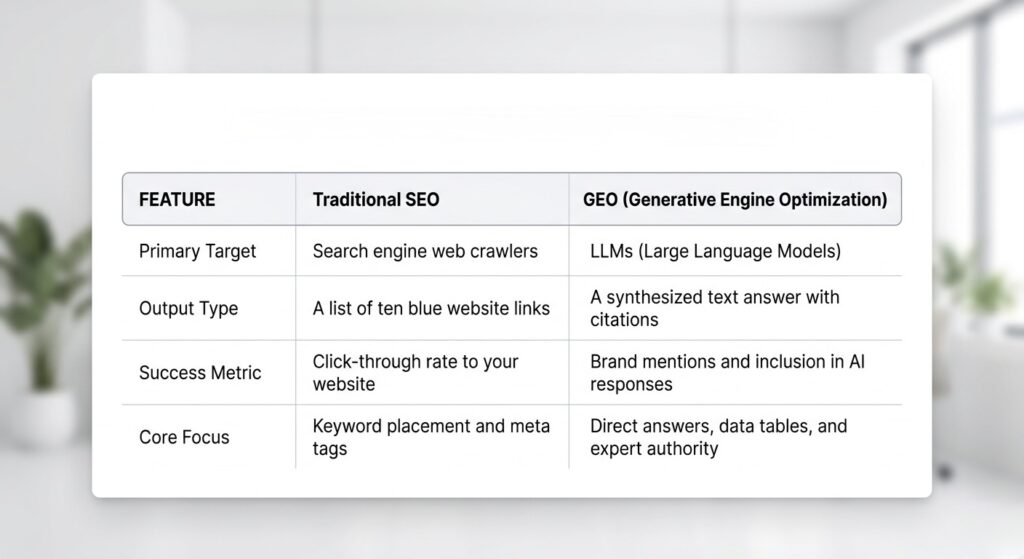
Honestly, here is what surprises me about most entrepreneurs we talk to. They think they can simply write longer blog posts to win this game. They are mistaken. Traditional tactics optimize for clicks. AI search optimization optimizes for inclusion.
3. Key Benefits of GEO for Your Business
Traditional SEO lands you on a list of blue links, but GEO drops your brand right into the middle of a live conversation. When a user asks an AI tool a question, you want to be the answer it gives. Shifting your focus to Generative Engine Optimization changes the game for a few very specific reasons:
• It builds instant, unshakeable authority. Think about what happens when someone throws a complex, industry-specific question at an AI model, and it pulls your brand or data as the prime example. That isn’t just a ranking, it’s an immediate stamp of credibility that tells the user you know exactly what you’re talking about.
• You’re catching leads at the absolute best time. People don’t usually turn to AI for casual browsing; they’re deep in research mode or actively trying to solve a problem. If you are the solution the AI brings up and links to, you’re hitting potential customers at the exact millisecond they are ready to act.
• It future-proofs your digital footprint. The way people look for information online is changing faster than most businesses can keep up with. By optimizing for AI models right now, you’re making sure your business stays highly visible as conversational tools take over the traditional search market.
• Trust translates directly into conversions. When an engine quotes your data or recommends your service, it doesn’t feel like a pitch—it feels like an objective, third-party endorsement that naturally drives higher conversion rates.
4. Core GEO Strategies and Best Practices
Getting an AI engine to cite your business isn’t about gaming an algorithm or stuffing keywords into a paragraph anymore. It’s about making your information so clear, verified, and undeniable that the machine wants to use it as proof.
If you want to build a real strategy around this, here is what actually moves the needle:
• Write for how people talk, not how they type.
Nobody types “best marketing agency” into an AI chat. They ask something specific, like, “I run a small firm and need a localized ad campaign, who should I hire?” Your content needs to address those exact, multi-layered questions directly. Use conversational headers and answer things straight up.
• Give it hard data it can’t find anywhere else.
AI models love numbers and case studies because facts make their answers look smart. If your articles are just generic filler, you’ll get ignored. Publish your own original data, unique experiments, or specific statistics. Give the AI a solid chunk of proprietary information that it has to link back to you to use.
• Optimize for specific AI personas.
Different AI engines have distinct “personalities” and preferences based on how they were trained. ChatGPT loves deep, structured explanations; Perplexity hunts for real-time citations and links; Gemini relies heavily on Google’s ecosystem and local data. Tweak your content format depending on which platform your target audience actually uses.
• Inject authoritative quotes from real experts.
AI algorithms are getting incredibly good at spotting generic text. One of the easiest ways to prove your content is high-quality is to include direct quotes, unique perspectives, or contrarian opinions from actual industry veterans. When an AI crawler sees a quote from someone with a verified digital footprint, it signals that your page is a primary source.
• Create a dedicated FAQ section for voice and chat search.
People talk to AI assistants like they are talking to a colleague, using full sentences, questions, and follow-ups. Adding a highly natural, question-and-answer format at the bottom of your core pages makes it incredibly easy for an AI to scrape your exact answer when a user asks a matching question. Keep the question natural and the answer blunt.
• Leverage digital PR and unlinked brand mentions.
Sometimes, you don’t even need a link back to your site for an AI to notice you. If your brand name is consistently mentioned alongside specific keywords across news sites, press releases, and industry blogs, the AI’s large language model maps those concepts together. It learns through association that you are the go-to answer for that topic.
• Clean up your technical backend.
Think of Schema markup as a direct line to the AI’s web-crawler. If your site’s structured data is a mess, the machine won’t waste time trying to decode it. Clear technical tags tell the crawler exactly who you are and what you do, making you an easy source to pull from.
• Fix your reputation outside your own website.
AI doesn’t just read your homepage; it looks at the whole web to see if you’re legit. Your business details, reviews, and mentions across third-party platforms and directories need to be solid and consistent. If the internet agrees you’re an authority, the AI will too.
5. How to Get Started with GEO Today
Start by testing how the major engines perceive your brand right now. Type your industry and location into Gemini or ChatGPT. See if your business appears in the summary. If you are missing, you need to reconstruct your content strategy immediately.
Update your core service pages with clear FAQ sections that answer specific consumer pain points. Do this because it provides the exact question-and-answer format that generative engines search for.
At Five Talents, we specialize in helping small businesses protect their revenue through this massive shift. Review our portfolio of case studies to see how we help entrepreneurs secure their digital lead flow. Reach out to our team today to analyze your current AI visibility.
SEO in 2026: Why Most Businesses Still Don’t Rank (And What Actually Works Now)
Many small businesses spend money on SEO but still feel invisible.
They publish blog posts. They add keywords to service pages. They wait for Google to notice. Then months pass, and the phone still does not ring enough to justify the cost. Honestly, this is where many owners lose trust in SEO.
When every dollar matters, “better visibility” is not enough. You need rankings that bring buyers, calls, and revenue.
Why SEO Services for Small Businesses 2026 Often Fail
The problem is not SEO itself. The problem is scattered SEO.
Many companies treat search engine optimization like a checklist. Add a title tag. Write a blog. Insert a keyword. Build a few links. That approach worked better years ago, when competition was weaker.
Now Google rewards depth, clarity, usefulness, and trust across the website. Weak pages do not rank just because they include the right phrase. Thin blogs do not win because they repeat a keyword. A slow website does not convert because the design looks nice.
This is why SEO services for small businesses 2026 must connect strategy, content, technical health, and conversion. Without that connection, you get traffic that does not convert.
What Actually Works for Business Growth
Professional SEO services for business growth start with intent. We do not ask only, “What keywords can we use?” We ask, “What is your buyer trying to solve, and what page should meet that need?”
That shift changes the work.
A local contractor does not need random blog traffic from people outside the service area. A medical office does not need vague clicks from the wrong city. A B2B company does not need visitors who read one article and disappear. You need the right person landing on the right page with enough trust to act.
That is where SEO consultant services for local ranking become practical. Local SEO needs clear service pages, strong location signals, useful content, a review strategy, and a website that makes action easy.
Content Marketing Services for SEO Results Need Purpose
Here is what surprises me. Many businesses want rankings, but their websites do not answer the questions buyers ask before they purchase.
Content marketing services for SEO results shouldn’t mean publishing random articles just because the calendar is empty. Content should remove doubt. It should explain cost, compare options, show proof, and help a cautious buyer feel safe enough to contact you.
A service page should not only say what you offer. It should explain who the service is for, what problem it solves, how your process works, and why your company can be trusted.
Website Design Services for SEO Performance Matter
A beautiful website can still lose money.
If the site loads slowly, hides the CTA, buries service details, or forces users to guess what to do next, it won’t save rankings. Website design services for SEO performance matter because Google may send visitors, but the website must turn them into leads.
We look at SEO and design together. Your pages need a clean structure, readable sections, internal links, fast performance, mobile usability, and clear conversion paths. Search engines need to understand the page. Humans need to trust it.
How Five Talents Builds SEO for Online Growth
At Five Talents, we combine digital marketing services for online growth with practical SEO execution. We audit what blocks rankings, fix weak website structure, build content around buyer intent, improve local visibility, and track the actions that matter most.
A digital marketing agency for SEO strategy should not chase vanity traffic. We care about qualified leads, lower customer acquisition costs, stronger organic visibility, and a website that works harder for the money you already spend.
If your business needs search engine optimization services USA that connect SEO, content, local ranking, and website performance, Five Talents can help you build a clearer path to growth. Contact us or check our portfolio to see how we turn search visibility into measurable results.
Business Growth Is Not Marketing: What You Actually Need to Scale Predictably
More leads will not fix a business that leaks money, time, and attention.
Many small businesses come to us asking for ads, SEO, content, or a better website. Those things matter. We provide them every day. But you need to understand that marketing alone cannot sustain a company without a clear growth system behind it.
If your offer is unclear, your sales process is weak, your website does not convert, and your team cannot follow up fast enough, more traffic only exposes the problem faster.
That is why business growth consulting for scaling companies starts before the campaign starts.
Why Marketing Alone Does Not Create Predictable Growth
Many business owners keep investing in marketing when the real issue lies deeper.
They run ads but do not know their real customer acquisition cost. They post on social media but cannot explain who they serve best. They hire an SEO team but send visitors to a website that neither builds trust nor drives action.
That is not growth. That is guessing with a budget.
Strong growth strategy consulting for predictable growth looks at the full path. Where do leads come from? What do they see first? What makes them hesitate? Who follows up? How long does the sale take? Where do people drop off?
When we understand that, marketing becomes sharper. Money works harder.
Business Strategy Services for Scaling Businesses Start With Clarity
A scaling company needs more than visibility. It needs direction.
Our business strategy services for scaling businesses focus on the real numbers behind growth. We look at your offer, audience, messaging, website, sales funnel, SEO visibility, paid ads, and follow-up process. Not as separate pieces. As one connected system.
Because small businesses count every penny, we do not recommend engaging in activity for its own sake. We look for what reduces waste.
Sometimes that means improving your landing page before increasing ad spend. Sometimes it means tightening your messaging before writing new content. Sometimes it means fixing your lead forms, email flow, or call booking process before launching another campaign.
This is where marketing consulting for business growth becomes practical. You stop asking, “What should we post?” and start asking, “What actually moves people closer to buying?”
Digital Growth Consulting for Scaling Companies Must Connect Strategy and Execution
Advice alone does not scale a business. Execution does.
At Five Talents, our role is not only to tell you what is broken. We help you build the assets that support growth. That includes website design, SEO, content, branding, paid ads, copywriting, analytics, and conversion improvements.
A digital marketing consultant for business growth should not only talk about traffic. Traffic is only useful when it brings the right people and gives them a reason to act.
That is why digital growth consulting for scaling companies must answer specific questions:
Does your website explain your value in seconds?
Do your service pages address real buyer pain points?
Do your ads match the landing page?
Do your SEO keywords attract buyers or casual readers?
Do you know which channels produce qualified leads?
These questions save money. They also protect the business from random marketing decisions that look busy but produce weak results.
What Predictable Scaling Looks Like
Predictable growth does not mean every month looks perfect. It means you understand what drives results and where to adjust when numbers change.
A strong system gives you higher-quality leads, cleaner messaging, higher conversion rates, and clearer reporting. You know which campaigns deserve more budget. You know which pages need improvement. You know where sales conversations break down.
That is the difference between hiring an internet marketing company for business growth and partnering with a team that understands business strategy.
A true digital marketing agency for scaling businesses does not only chase clicks. It helps you stabilize your lead flow, cut wasted spend, improve conversion paths, and build confidence in your next move.
Five Talents Helps You Build the Growth System Behind the Marketing
If your business feels stuck, the answer is not always “do more marketing.” The answer is to build a smarter growth engine.
At Five Talents, we help small businesses identify gaps, sharpen their strategy, and create the digital assets needed to scale with greater control. If you want marketing that drives real business growth, contact us or review our portfolio to see how we help companies move from scattered efforts to measurable progress.
What a High-Converting Landing Page Actually Looks Like (With Real Structure Breakdown)
Landing page. — is a standalone web page built for one specific marketing goal. It’s where people land after clicking your ad, email link, or social media post. While your homepage lets people browse, a landing page focuses entirely on getting visitors to take a single action, such as signing up or buying a product.
It cuts out the distractions so your audience can focus entirely on what you are offering. But making a page that just looks good isn’t enough; it takes the right mix of clear writing and smart design to actually get results.
In this article, we would like to show you the landing pages that actually convert, how they should look, and what you have to keep in mind while working on your own.
The First Screen Must Do the Heavy Work
The top section decides whether people stay or leave. It needs a clear headline, one sharp benefit, a simple explanation, and one CTA that tells the visitor exactly what to do next.
A weak landing page design tries to say everything at once. Strong conversion-focused web design removes friction. The visitor should know three things within seconds: what you offer, why it matters, and why they should trust you.
For example, instead of saying “Professional solutions for business growth,” say what the customer actually receives. More booked calls. Better qualified leads. Lower wasted ad spend.
That is how landing page copywriting services support ROI. Good copy does not decorate the page. It guides the buyer.
Your Offer Needs More Than a Button
A high-converting page explains the offer in plain language. What is included? Who is it for? What problem does it solve? What happens after someone fills out the form?
This is especially important for small businesses because every lead has a cost. If you use paid traffic, your landing page must protect your budget. That is why PPC landing page optimization services and paid media landing page optimization should work together. Ads bring the click. The landing page earns the conversion.
Honestly, sending PPC traffic to a general homepage is one of the easiest ways to waste money. A homepage gives options. A landing page gives direction.
A Real Landing Page Structure That Works
A strong structure usually looks like this:
• Hero section: Clear promise, simple subtext, strong CTA.
• Problem section: Show the visitor you understand what they are facing.
• Solution section: Explain your service without overloading them.
• Proof section: Add testimonials, results, case studies, or portfolio examples.
• Process section: Show what happens after they contact you.
• FAQ section: Remove doubts before they become objections.
• Final CTA: Invite the visitor to take action without pressure.
This structure works because it follows the buyer’s thoughts in the right order. First, they ask, “Is this for me?” Then, “Can I trust them?” Then, “What happens next?”
Content Matters as Much as Design
Many landing pages fail because their visuals and copy don’t work together. The page looks polished, but the message feels vague. Or the copy is strong, but the design hides the most important points.
That is why landing page content creation services need a strategy. Every headline, section, image, form field, and CTA should support one goal.
At Five Talents, we build landing pages with conversion in mind from the first wireframe. We look at the offer, the traffic source, the audience, and the action you want people to take. Then we shape the page around that goal.
This is not about making a prettier page. It is about making your marketing money work harder.
What We Focus on at Five Talents
We help businesses create landing pages that are clear, fast, persuasive, and built around measurable action. Our team handles landing page design, copy, layout, SEO basics, and conversion flow, so your page does not just attract visitors. It helps turn them into leads.
If your ads are getting clicks but your leads are weak, the problem is often not the campaign. It is the page after the click.
Let Five Talents review your landing page, rebuild the structure, or create a new one designed for better conversions. Contact us or check our portfolio to see how thoughtful design and sharper messaging can stabilize your lead flow.
Stop Posting, Start Converting: A Smarter Approach to Social Media Marketing
Do you post on social media every single week, but your phone still isn’t ringing? Your page looks busy, but sales aren’t moving, and new leads aren’t showing up. It’s enough to make you wonder why you’re putting in all this effort in the first place.
It’s important to realize that having an active feed doesn’t guarantee sales. If your posts don’t build trust or encourage action, social media can end up just draining your budget.
Why Random Posting Fails Small Businesses
Many companies use social media like a bulletin board. They post a photo, a quick update, a holiday message, or some tips, then return later just to keep the page from looking empty.
But this approach doesn’t help you get leads. It just keeps things moving, and movement without direction rarely leads to more sales.
Many companies that have approached us to improve their social media marketing had plenty of content ideas, but they didn’t have a plan for turning those ideas into sales. They need posts that answer buyer questions, build trust, show real value, and encourage people to take action.
Social Media Management for Conversions Starts With Intent
Effective social media for conversions starts before you even post. First, figure out who you want to reach, what problems they have, what holds them back from buying, and what message will help them decide.
This changes your whole approach. Each post isn’t just content anymore—it’s a chance to start a sales conversation.
Some posts should teach, some should build trust, some should show proof, and some should ask people to act. When these work together, your content does more than just get seen—it helps drive sales.
Effective Approaches to SMM Strategy
If you want your social channels to bring in real revenue, you need a clear plan. A good social media strategy is built on four key steps:
• Audience Mapping: Don’t try to reach everyone. Figure out exactly who your ideal customer is, what problems they deal with, and where they go online to find answers.
• The Content Matrix: Keep your feed balanced by sorting posts into four types—Educate (solve simple problems), Validate (share case studies and reviews), Engage (start conversations and polls), and Convert (make direct offers and give clear next steps).
• The Content Pipeline: Stay consistent and avoid burnout by planning your topics a month ahead. Make sure every post supports a specific business goal.
• Data-Driven Adjustments: Check your numbers every week. Instead of focusing on likes or followers, track things that matter—like click-through rates, direct messages about pricing, and link clicks.
Content for Social Media Conversions Needs a Clear Job
A good post doesn’t need to impress everyone. It should reach the right person at the right time.
People who don’t know you yet need simple info and a reason to care. Those who are interested need proof, comparisons, and reassurance. Ready buyers want a clear offer, a direct call to action, and an easy-to-use landing page.
That’s how we handle social media content at Five Talents. We don’t focus on likes as the main goal. Likes are nice, but leads pay the bills, and sales keep the business running.
Advice for Content Mapping
To make this work, match your social media posts to the three main stages of the customer journey:
• Top of Funnel (TOFU) – Cold Audience: These people don’t know your brand yet, but they have a problem you can solve. Share educational reels, quick tips, myth-busting posts, and how-to guides. Use simple calls to action like “Save this post for later” or “Follow for daily tips.”
• Middle of Funnel (MOFU) – Warm Audience: These people know your brand and are comparing options. Share client video testimonials, detailed case studies, and before-and-after stories to build trust. Encourage action with calls to action like “Read the full story on our blog” or “Comment ‘GUIDE’ to get the breakdown.”
• Bottom of Funnel (BOFU) – Hot Audience: These people are ready to buy but need a final nudge. Share direct offers, limited-time deals, and clear FAQ posts. Use strong calls to action like “Click the link in our bio to book your consultation” or “Send us a DM to claim your spot.”
Social Media Ads for Conversions Need More Than a Boost Button
Boosting a post without a plan is a quick way to waste your ad budget. The platform takes your money, but you get a few clicks and no real results.
To get real results from social media ads, you need better targeting, strong visuals, good copy, clear tracking, and a landing page designed to convert. The ad alone can’t do all the work.
This is where paid social becomes useful for sales. We test different messages, see which audiences respond, stop what wastes money, and put more into what brings good leads. Small businesses need this focus because every dollar counts.
PPC for Social Media Works When the Funnel Is Honest
Good PPC for social media isn’t about making big promises. It gives your offer a clear, trackable path. The ad gets attention, your content builds trust, the landing page explains the value, and follow-up turns interest into real conversations.
If one part fails, conversions go down. That’s why we focus on the whole process, not just the campaign settings.
Branding for Social Conversions Builds Trust Faster
People buy from businesses they know and trust. Weak branding can make even a great offer seem risky. Strong branding helps your message stand out, stick in people’s minds, and feel believable.
Your visuals, tone, offers, proof, and website should all feel connected. When they do, people stop seeing you as just another company and start seeing you as a real, trustworthy business.
What Five Talents Focuses on First
We help small businesses stop guessing. We create social strategies focused on generating leads, understanding buyer intent, running paid campaigns, planning content, and building a brand that drives conversions.
The goal isn’t to post more often. It’s to make every post and ad work harder for your business.
If your social media looks busy but isn’t bringing in enough leads, Five Talents can help. Reach out or look at our portfolio to see how a better strategy can turn attention into real business growth.
The Hidden Cost of a Cheap Website: Why “Affordable” Design Often Means Lost Leads
When cash is tight, a cheap website feels like the responsible choice, and we genuinely understand why. Small business owners count every dollar. Nobody wants to overpay for design, development, copy, branding, or SEO.
But here’s the catch. A website that costs less to build can quietly cost you more every single month it’s live, because it doesn’t sell, doesn’t guide anyone, and doesn’t turn attention into real leads.
Good Design Isn’t About Looking Nice—It’s About What Happens Next
Ask most business owners what “web design” means, and you’ll hear the same answers: colors, images, fonts, and a clean homepage. However, you need to understand that all these things are just the surface.
Web design that actually converts has to answer a far more practical question: what should a visitor do after landing on your site? Should they call you? Book a consultation? Fill out a form? Request pricing? Read your proof and trust you enough to take the next step?
If your website looks fine but visitors leave without doing anything, the design isn’t working. You’ve paid for a decoration when you needed a sales tool.
Why Cheap Design Quietly Stalls Small Business Growth
Small businesses don’t need a website just to “be online.” They need one that supports growth, brings in leads, and lowers the cost of winning each new customer.
That’s why good website design for a growing small business has to look past layout. It means thinking carefully about user behavior, page structure, calls to action, mobile experience, messaging, speed, and search visibility.
A cheap website usually skips all of that, because nobody has the time to think it through. The designer builds something acceptable, the owner approves it, the site goes live, and then the months pass with no calls, no leads, no movement.
What a Leaking Website Actually Looks Like
Picture a local HVAC company. They’re paying for ads, traffic is coming in, and the phone stays quiet. The owner is convinced demand has dried up.
But pull up the site on a phone, where most people will see it. The headline reads “Welcome to Our Website.” The contact number is buried in the footer. The quote form asks for eleven fields. A visitor with a broken AC and three other tabs open isn’t going to fight through that. They bounce in seconds.
The traffic was never the problem. The website was.
Responsive Design Isn’t a Technical Extra—It’s Business Protection
Most visitors judge your business from a phone screen. If your site loads slowly, hides the contact button, or makes it hard to finish forms, you lose the lead before the conversation even begins.
That’s why responsive design built for conversions isn’t a nice-to-have. It’s basic business protection. Mobile users scan fast, compare quickly, and decide in seconds whether your company feels trustworthy. A responsive site should carry them through with a clear headline, a clear offer, clear proof, and one clear action.
Custom Development Gives You Control as You Grow
Templates can help at the start, but they get expensive once your business outgrows them. Sooner or later, you need real landing pages, tracking, booking tools, forms, integrations, speed improvements, and a proper SEO structure.
That’s where custom development built around lead generation starts to make sense. Not every small business needs a complicated website, plenty don’t. But every business needs one built around how its customers actually make decisions.
At Five Talents, we focus on the full path. What does the visitor see first? What question do they have next? What proof removes the doubt? What button should they click? Those small details decide whether your website becomes a real asset or just another monthly frustration.
SEO, Copywriting, and Branding Have to Pull Together
Traffic alone won’t fix a weak website. More visitors just expose the problem faster.
That’s why SEO can’t be treated separately from conversion. Search strategy and conversion strategy have to connect: strong SEO brings the right people in, strong design helps them stay, and strong copy helps them act. Your pages need proper headings, real search intent, fast load times, sound internal structure, and content that answers the concerns customers actually have.
The same goes for copy and branding. Sharp copywriting explains your offer, removes hesitation, and shows why your company is the safer choice. Consistent branding makes your business look serious, credible, and memorable. People buy from businesses they understand and trust—your website has to build both, and build them fast.
Before You Take the Cheapest Quote
Before you sign off on the lowest offer, ask what the website is actually supposed to accomplish. Will it generate leads? Support your SEO? Work smoothly on mobile? Explain your services clearly? Help people contact you without friction?
If the answer is no, that low price isn’t a bargain. It’s a delay that quietly drains leads every week.
At Five Talents, we build websites with growth, clarity, SEO, and lead generation in mind from the start. If your current site looks fine but isn’t delivering results, contact us or take a look at our portfolio. Let’s find where your conversions are leaking and fix what’s costing you money.
Why Your Google Ads Don’t Work Even If You’re Spending More Every Month
You can spend more on Google Ads and still get fewer good leads. The problem is usually waste. Wrong keywords, weak landing pages, broad targeting, and poor tracking. Ads that attract clicks but not buyers.
That is why many business owners search for why Google Ads campaigns don’t work, only after months of spending money with little to show for it.
The Real Reason Google Ads Feel Expensive
Google Ads become expensive when the campaign pays for attention rather than for intent. A click does not mean a customer wants to buy. A form submission does not mean the lead is qualified. A high impression count does not mean the campaign works.
Many campaigns look active, but they are not managed with business goals in mind. They collect traffic. They do not protect profit.
Strong Google Ads management for higher conversions starts with asking better questions. Which keywords bring real buyers? Which locations waste budget? Which ads create calls? Which landing page sections help people trust you enough to act?
Without those answers, the campaign keeps spending. The business keeps guessing.
How to Fix Underperforming Google Ads Without Burning More Budget
The first step in fixing underperforming Google Ads is not increasing your daily spend. It is a cleaning campaign. Below you will see the most important points you have to check in your ad campaigns:
- The first thing you have to do is check the search terms, because that is where wasted money hides. If you run ads for “emergency HVAC repair,” but people click from searches like “free HVAC training” or “DIY AC repair,” your budget leaks every day.
- Then tighten match types, remove poor keywords, build negative keyword lists, and separate campaigns by intent. This works because Google needs clear direction. A campaign built for everyone usually converts no one well.
- Make sure to review the offer. If your ad says “Get a Free Quote,” but ten competitors say the same thing, you need a sharper reason to click. Better copy does not sound clever. It sounds useful.
The Importance of Your Landing Page
A strong ad cannot save a weak landing page. People click because they feel interest. They convert because they feel trust.
Your page should answer the buyer’s quiet questions fast. Can this company solve my problem? Do they serve my area? What happens after I submit the form? Why should I choose them instead of the next company?
This is where PPC advertising services need to go beyond ad setup to deliver better ROI. At Five Talents, we look at the full path from keyword to click to conversion. If the landing page loads slowly, hides the phone number, lacks proof, or asks for too much information, we fix that before scaling spend.
More budget on a weak page only buys more missed chances.
Paid Advertising Services That Reduce Wasted Spend
Good paid media is not about chasing cheap clicks. It is about paying for the clicks that have a real chance to become revenue.
At Five Talents, we offer paid advertising services that reduce wasted spend and focus on tracking, segmentation, and continuous improvement. We set up conversion tracking correctly. We separate lead types. We compare cost per lead with lead quality. We review what turns into booked calls, quotes, and sales. All these things are very important for successful ad campaigns.
This matters for small businesses as well because every penny counts. A campaign that brings 100 low-quality leads can exhaust your team. A campaign that brings 20 serious inquiries can change the month.
Google Ads and Social Ads Should Not Fight Each Other
Some businesses treat Google Ads and social media ads as two separate worlds. That creates confusion. Google captures demand. Social media creates demand and reminds people why your business matters.
When we use social media advertising services for lead generation, we build campaigns that support the buyer journey. A person may see your Facebook ad, visit your website, leave, search for your service later, and click your Google ad. If tracking is broken, you miss that story.
Paid channels work better when they talk to each other. Your message stays consistent. Your retargeting becomes smarter. Your lead flow becomes more stable.
Ready to Make Your Ad Spend Work Harder?
If your paid ads keep getting clicks but not enough customers, the issue can be fixed. Do not keep feeding a campaign that wastes money.
Five Talents helps businesses rebuild paid campaigns with cleaner targeting, stronger landing pages, better tracking, and smarter optimization. Contact us to discuss your Google Ads performance or review our portfolio to see how strategic digital marketing can help you cut waste and stabilize your lead flow.