
If you spent any part of this year looking at your Google Analytics, you probably noticed a quiet drop in traditional organic traffic. The search engine results page you relied on for years is disappearing. It is being replaced by instant, AI-generated answers that summarize everything for the user right at the top of the page.
We all know about SEO, but what about GEO? In this post, we’ll dive into Generative Engine Optimization and explain why it’s a must-have strategy for today’s businesses. If you want your company to go beyond basic online visibility and actually become a trusted authority that AI engines quote, this is for you.
1. What Is GEO (Generative Engine Optimization)?
Generative engine optimization, or GEO, is the process of optimizing your digital footprint so that AI models choose to recommend your business. When a potential customer asks Perplexity, ChatGPT, or Google Gemini for a local recommendation, those platforms do not return a standard list of websites. They write a custom response.
GEO marketing focuses on feeding these engines structured data, expert quotes, and authoritative facts. This ensures your brand is synthesized into that final AI answer. It is the evolution of traditional search tactics, specifically tailored for the algorithms dominating SEO in 2026.
2. GEO vs. SEO: What’s the Difference?
Traditional search optimization centers on keywords, backlink counts, and page load speeds. You optimize your site so a robot can index it easily. AI SEO requires an entirely different mindset. AI models do not just look at your website. They scan the entire internet to build a consensus about your business reputation.
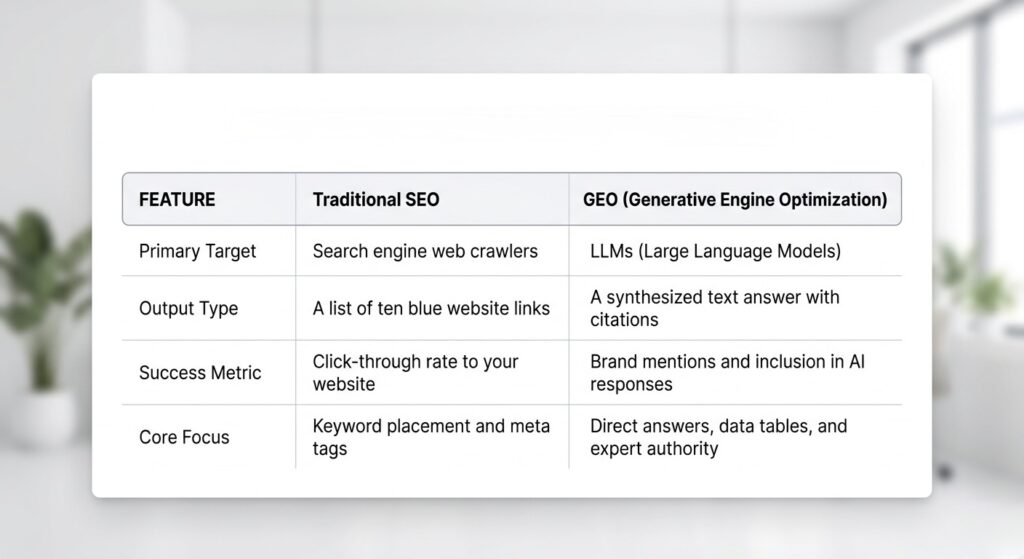
Honestly, here is what surprises me about most entrepreneurs we talk to. They think they can simply write longer blog posts to win this game. They are mistaken. Traditional tactics optimize for clicks. AI search optimization optimizes for inclusion.
3. Key Benefits of GEO for Your Business
Traditional SEO lands you on a list of blue links, but GEO drops your brand right into the middle of a live conversation. When a user asks an AI tool a question, you want to be the answer it gives. Shifting your focus to Generative Engine Optimization changes the game for a few very specific reasons:
• It builds instant, unshakeable authority. Think about what happens when someone throws a complex, industry-specific question at an AI model, and it pulls your brand or data as the prime example. That isn’t just a ranking, it’s an immediate stamp of credibility that tells the user you know exactly what you’re talking about.
• You’re catching leads at the absolute best time. People don’t usually turn to AI for casual browsing; they’re deep in research mode or actively trying to solve a problem. If you are the solution the AI brings up and links to, you’re hitting potential customers at the exact millisecond they are ready to act.
• It future-proofs your digital footprint. The way people look for information online is changing faster than most businesses can keep up with. By optimizing for AI models right now, you’re making sure your business stays highly visible as conversational tools take over the traditional search market.
• Trust translates directly into conversions. When an engine quotes your data or recommends your service, it doesn’t feel like a pitch—it feels like an objective, third-party endorsement that naturally drives higher conversion rates.
4. Core GEO Strategies and Best Practices
Getting an AI engine to cite your business isn’t about gaming an algorithm or stuffing keywords into a paragraph anymore. It’s about making your information so clear, verified, and undeniable that the machine wants to use it as proof.
If you want to build a real strategy around this, here is what actually moves the needle:
• Write for how people talk, not how they type.
Nobody types “best marketing agency” into an AI chat. They ask something specific, like, “I run a small firm and need a localized ad campaign, who should I hire?” Your content needs to address those exact, multi-layered questions directly. Use conversational headers and answer things straight up.
• Give it hard data it can’t find anywhere else.
AI models love numbers and case studies because facts make their answers look smart. If your articles are just generic filler, you’ll get ignored. Publish your own original data, unique experiments, or specific statistics. Give the AI a solid chunk of proprietary information that it has to link back to you to use.
• Optimize for specific AI personas.
Different AI engines have distinct “personalities” and preferences based on how they were trained. ChatGPT loves deep, structured explanations; Perplexity hunts for real-time citations and links; Gemini relies heavily on Google’s ecosystem and local data. Tweak your content format depending on which platform your target audience actually uses.
• Inject authoritative quotes from real experts.
AI algorithms are getting incredibly good at spotting generic text. One of the easiest ways to prove your content is high-quality is to include direct quotes, unique perspectives, or contrarian opinions from actual industry veterans. When an AI crawler sees a quote from someone with a verified digital footprint, it signals that your page is a primary source.
• Create a dedicated FAQ section for voice and chat search.
People talk to AI assistants like they are talking to a colleague, using full sentences, questions, and follow-ups. Adding a highly natural, question-and-answer format at the bottom of your core pages makes it incredibly easy for an AI to scrape your exact answer when a user asks a matching question. Keep the question natural and the answer blunt.
• Leverage digital PR and unlinked brand mentions.
Sometimes, you don’t even need a link back to your site for an AI to notice you. If your brand name is consistently mentioned alongside specific keywords across news sites, press releases, and industry blogs, the AI’s large language model maps those concepts together. It learns through association that you are the go-to answer for that topic.
• Clean up your technical backend.
Think of Schema markup as a direct line to the AI’s web-crawler. If your site’s structured data is a mess, the machine won’t waste time trying to decode it. Clear technical tags tell the crawler exactly who you are and what you do, making you an easy source to pull from.
• Fix your reputation outside your own website.
AI doesn’t just read your homepage; it looks at the whole web to see if you’re legit. Your business details, reviews, and mentions across third-party platforms and directories need to be solid and consistent. If the internet agrees you’re an authority, the AI will too.
5. How to Get Started with GEO Today
Start by testing how the major engines perceive your brand right now. Type your industry and location into Gemini or ChatGPT. See if your business appears in the summary. If you are missing, you need to reconstruct your content strategy immediately.
Update your core service pages with clear FAQ sections that answer specific consumer pain points. Do this because it provides the exact question-and-answer format that generative engines search for.
At Five Talents, we specialize in helping small businesses protect their revenue through this massive shift. Review our portfolio of case studies to see how we help entrepreneurs secure their digital lead flow. Reach out to our team today to analyze your current AI visibility.